
Places You Can Hang
“Places You Can Hang” is a longstanding monthly column initiated by Boston Hassle’s Dan Shea for the Boston Compass arts & culture newspaper, a project of Brain Arts Organization, featuring a rotating cast of contributing authors. Thus far I have contributed three Places You Can Hang articles to the Compass, posted below.
Places You Can Hang: The Franklin Park Wilderness
Franklin Park: the true people’s gem of Boston’s Emerald Necklace park system. Together, the Zoo, Golf Course, Stadium, Playstead, and Schoolmasters Hill attract Bostonians of every conceivable stripe.
Then there’s the Wilderness. Its few paved pathways, frequented by dog walkers, lead to its few official features: the Overlook Shelter Ruins, the Picnic Grove, the 99 Steps.
Break off into a maze of tiny trails amidst a rocky oak forest and you may encounter some unofficial features: The Cave, The Cliff, The Cages, The Moon…
What happens here? Seek and find the many Direct Actions, real honest-to-goodness Anarchism: fire pits; freshly painted remains of long-discarded cars and safes, renewed by an unknown creative caste; sacred forts of found wood and miscellanea offerings.
The Wilderness’ assets owe to its seclusion. To only breathe here is to receive a primal reminder that we, like the trees, draw our energy up from the earth, stretch out to collect and channel light from the heavens, thereby nourishing ourselves and one another.
An apropos Merriam-Webster definition of “wilderness”: a part of a garden devoted to wild growth. Yet it is not the forest that is free to grow wild, but your SPIRIT.

Places You Can Hang: The VU
You probably don’t need me to tell you the Video Underground in JP is the spot to find DVDs of the rare, local, foreign, cult, kitsch, and classic variety. But do you know it’s a place you can hang? Maybe so. After all, Kevin, the friendly and fastidious proprietor, has been hosting weekly $5 screenings for a quite some time, complete with thoughtful introductions and fresh popcorn galore. Or if you’re like me, whose idea of hanging is standing around drinking coffee, talking about films and gentrification, then yes, you know. But most folks of the underground ilk find that to truly hang it’s apropos to sit, relax, stretch out the legs and take time with that smooth cup of joe, place it down between sips, pick up an art rag and ponder what the night may bring.
I’m here to tell you now what you most likely don’t know – the VU is becoming just such a place to hang. They’re expanding the 3203 Washington Street outfit to include cafe seating, a menu of fine crepes (gluten-free and vegan!), a separate cinema screening area, all the best caffeinated drinks in town, plus a few refreshing options for the somehow-naturally-stimulated set. Did I mention Kevin is friendly, knows his flicks, and genuinely loves his work? Have you seen Clerks? He’s not that guy.
Support the underground. Get hopped up; chow. Watch movies. Talk to Kevin; talk amongst yourselves. Hang at the new VU.
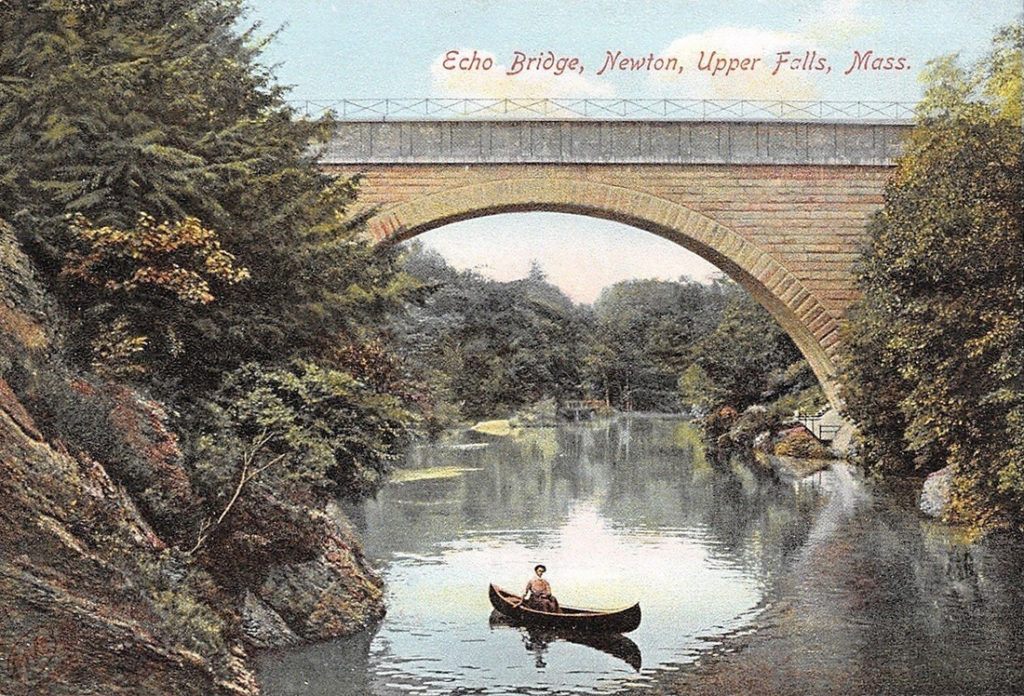
Places You Can Hang: Echo Bridge
Built in 1876, the Sudbury Aqueduct carries fresh water from Farm Pond in Framingham to the Chestnut Hill Reservoir in Brighton. Along its way is Echo Bridge, an American Water Landmark, spanning the Charles River at Hemlock Gorge between Needham and Newton Upper Falls.
The gorge offers scenic, secluded trails on both steep banks. Descending from the Needham side leads to a boardwalk, then onto a peninsula featuring the craggy puddingstone ledge “Devil’s Den” and an abandoned nail factory. The views from atop the bridge, of forest, valley, silk mill and waterfalls, are right out of a postcard.
The real place to hang, however, is under the bridge on the Newton side, on the deck, with some friends if you can rally them, with some musical instruments if you can carry them, or with only your stomping feet, clapping hands, and projected voice. The echo is exceptional – a natural delay pedal. Play a call-and-response rhythm, play sparse for a straight trance feel, or find the pocket, hit between the echoes and play a triplet or 6/8 groove. Sing arpeggiating melodies or bend notes and you’ll harmonize with your own echo. If you’re more a dramatist or poet than musician, experimenting under Echo Bridge will no doubt be enjoyable and fruitful for your practice.
The Hemlock Gorge public parking lot is on Ellis Street in Newton just south of Route 9, or walk, bike, or “cab” it from the Eliot T-stop on the Green Line D-Line.